MAXXI — MAXXIperTUTTI
MAXXIperTUTTI
Client Request
MAXXI — the National Museum of 21st Century Arts in Rome — is one of Italy's leading institutions for contemporary art and architecture. As part of Italy's National Recovery and Resilience Plan (PNRR, Mission 1 – removing physical and cognitive barriers in museums, libraries and archives), MAXXI commissioned Isagog to design and build a conversational AI for visitors, covering access, orientation, personalization, engagement and participation — for every visitor, including people with cognitive disabilities, deafness, or visual impairments.
Challenges
A museum like MAXXI needs an AI that can answer very different questions — from "when does the bookshop close?" to "which young Italian artists have been exhibited here?" — while staying anchored to real, verifiable information rather than invented answers. And it has to do so for very different visitors, each expecting something different from the same question.
The hardest part: without profiling users — for privacy and ease of use — the system still had to adapt its language and content to each visitor's needs, whenever asked.
One AI, Six Specialized Agents
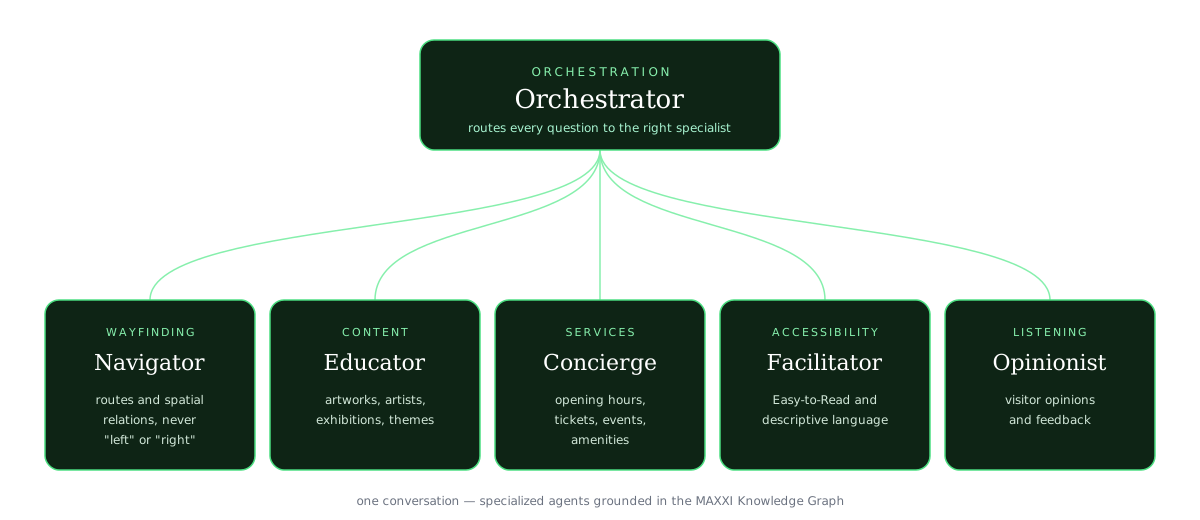
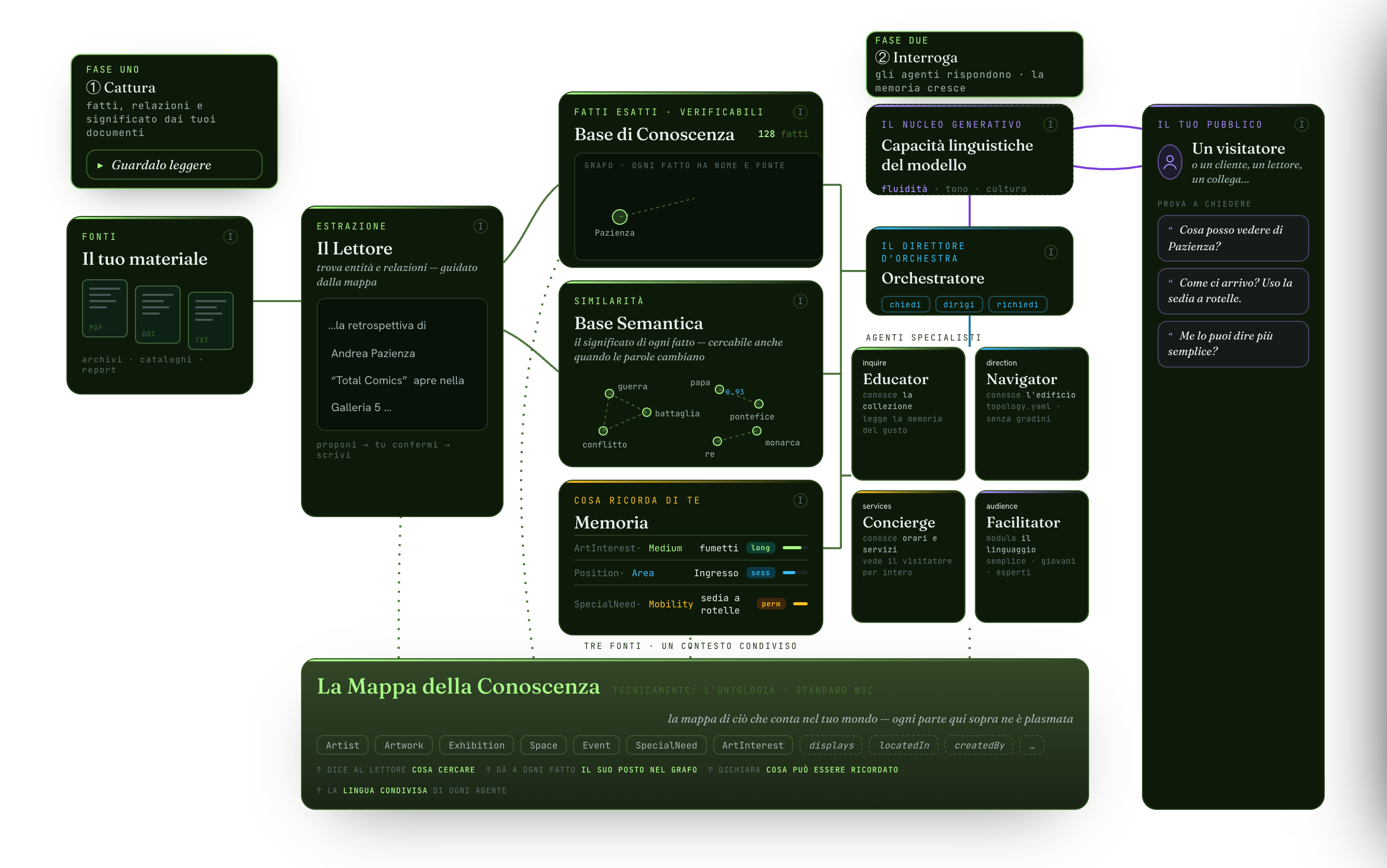
Isagog built an architecture that combines language models with structured knowledge: a curated Knowledge Graph — built on a dedicated ontology of around 70 classes, mapped to the international museum standard CIDOC-CRM and to Italy's cultural heritage catalogue (CIS/ArCo) — powers a system of specialized AI agents, each an expert in one task, coordinated by a central Orchestrator:
- Navigator — wayfinding: guides visitors between museum rooms using names and spatial relationships (never coordinates or "left/right", which depend on the visitor's point of view), reading and paraphrasing real, documented routes.
- Educator — content: answers questions about artworks, artists, exhibitions and themes, always grounded in the museum's Knowledge Graph — with Wikipedia used only as a declared fallback, never as a primary source.
- Concierge — services: opening hours, tickets, current events, amenities, in real time.
- Facilitator — language accessibility: on request, rephrases any answer in Easy-to-Read language (short sentences, common words, one idea per sentence) or in descriptive/visual language, using tactile and physical references instead of visual ones.
- Opinionist — listening: structurally collects visitor opinions and feedback, giving the museum a continuous listening channel.
The museum also received two platforms to manage the system independently, without depending on Isagog for every update:
- MAXXI Ingest — to upload catalogues and exhibition materials: the AI extracts artworks, authors and descriptions automatically, but a human curator always validates the result before it enters the system.
- MAXXI Interact — to configure the agents, monitor conversations in real time, and review collected feedback.
Tested With the People Who Would Really Use It
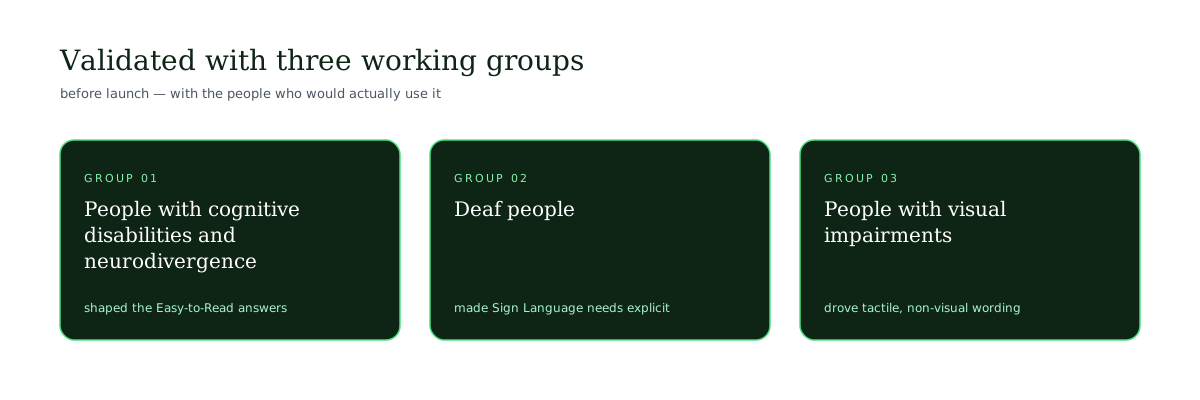
Before launch, the system was validated with three representative working groups — people with cognitive disabilities and neurodivergence, deaf people, and people with visual impairments. Not a generic test, but a direct comparison with the people who would actually experience the museum this way.
This process let Isagog distinguish, systematically and transparently, what genuinely needed fixing from what was simply expected system behavior — for example: without an explicit statement from the user, an AI cannot guess whether the person writing to it needs a tactile map or a Sign Language video.
System Architecture
Development
MAXXI's assistant runs on open, on-premise-capable language models: the museum keeps its independence from major — largely non-European — AI providers, and remains directly responsible for visitor data. No sensitive data is retained, even when a visitor shares it voluntarily. Compliance is native, not bolted on afterwards: GDPR, the AI Act, and the PNRR's "do no significant harm" principle were verified at every testing stage. Smaller, optimized models also mean a lighter environmental footprint.
The system is now in production with 6 specialized agents and one Orchestrator, running on the MAXXI Ontology v0.1 (~70 classes), interoperable with international museum standards. Content is already live on real exhibitions (including The Large Glass and Roma nel mondo), with APIs published to the OpenAPI standard.